Reviewing the Bunch of Tulip Flowers Blooming Redwork
As a designer who has spent countless hours digitizing and stitching out machine embroidery design files, I approach every new asset with a critical eye. It is not just about whether the image looks pretty on a screen; it is about how the needle interacts with the fabric, how the thread tension holds up, and ultimately, how the customer perceives the value of the finished product. Recently, I evaluated the Bunch of Tulip Flowers Blooming Redwork, a piece that immediately caught my attention for its simplicity and classic appeal. This is not a dense, heavy fill design, but rather a delicate arrangement that relies on line work and negative space to create its charm.
First Impressions and Visual Mood
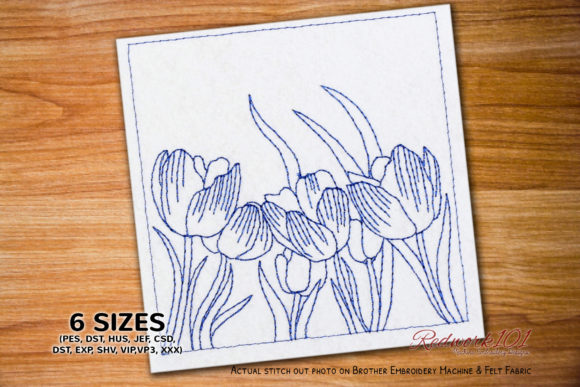
The moment I loaded the file into my editing software, the clean lines stood out. The description notes a "bunch of tulip flowers blooming in morning," and visually, this translates to an airy, optimistic aesthetic. Redwork traditionally uses a single color thread, often red, on a white or cream background, mimicking the historic quilting style. However, this design’s structure allows for versatility. The layout feels balanced, with stems curving naturally rather than rigidly, giving the bouquet a hand-drawn, organic feel. For those of us selling design assets or creating handmade products, this mood is crucial. It suggests warmth, tradition, and gentle elegance without being overly ornate.
What strikes me most is the restraint in detail. In an era where complex 3D puff embroidery and dense satin fills dominate, a well-executed line-art design offers a refreshing change. It breathes. The visual personality here is understated, making it suitable for projects where subtlety is preferred over flashiness. This is particularly important for Etsy sellers and small shop owners who cater to clients seeking minimalist or farmhouse-style decor.
Real-World Application: The Tote Bag Test
To truly understand the viability of this embroidery file, I simulated a real-life scenario: a custom canvas tote bag for a spring farmers' market collection. Canvas is a sturdy, textured fabric that can sometimes swallow fine details if the stitch density is too low or the needle is too small. Given that this is a redwork-style design, likely composed primarily of running stitch elements, the interaction with the fabric texture is key.
In this context, the Bunch of Tulip Flowers Blooming Redwork performs exceptionally well. Because it lacks heavy fill stitch areas, it does not pucker the canvas. The open nature of the design allows the natural weave of the tote material to show through, enhancing the rustic, handmade vibe. If I were producing this for a craft business, I would confidently market it as a lightweight, durable addition to everyday carry items. It does not add bulk, which is a significant selling point for functional items like bags and aprons.
Versatility Across Product Lines
Beyond totes, this design shines in several other categories. For custom apparel, such as a linen button-down or a cotton sweatshirt, the design acts as a sophisticated accent. Placed on the left chest of a sweatshirt embroidery project, it adds a touch of femininity without overwhelming the garment. It is also an excellent candidate for baby embroidery. On a muslin swaddle or a cotton onesie, the soft lines are gentle against sensitive skin, provided the backing is trimmed correctly and no scratchy stabilizer remains.
For holiday embroidery or seasonal gifts, this bouquet fits perfectly into spring and Easter collections. It can be easily adapted for personalized gift items by adding a monogram below the stems. The simplicity of the tulips ensures that any added text does not compete for visual attention. Furthermore, for those creating embroidered patch designs, this outline-heavy style is ideal for cut-edge appliques or simple merrowed edges, reducing production time and material costs.
Technical Considerations and Fabric Constraints
While the design is versatile, it requires careful handling in specific situations. Since redwork relies on continuous lines, the integrity of the stitch density is vital. On stretchy fabrics like jersey knits, a proper cut-away stabilizer is non-negotiable to prevent distortion. Without it, the running stitches may gap or pull, ruining the clean look of the tulips.
Additionally, when working with dark fabrics, contrast becomes the primary challenge. Traditional redwork depends on high contrast. If you are stitching this on navy or black, you must choose a vibrant thread color—such as bright coral, yellow, or white—to ensure the thread colors pop. A muted tone will disappear into the background. I always recommend testing the design on scrap fabric first, especially when changing from light to dark backgrounds, to verify visibility.
Another consideration is the hoop size. While the design appears compact, you must confirm the actual dimensions in your software. If the bouquet is large, it may not fit on a standard 4x4 inch hoop, requiring a 5x7 or larger frame. Always check the specific file details before starting a project to avoid mid-stitch hoop changes or resizing issues that can distort the aspect ratio.
Commercial Value and Brand Consistency
For commercial embroidery professionals, this design offers high perceived value with low machine time. Efficiency is profit. A design that stitches quickly but looks elegant allows for higher turnover in production runs. Whether you are creating tote bag design batches for a boutique or personalized kitchen towels for wedding favors, the speed of execution matters.
Moreover, using consistent, high-quality motifs like this helps build brand recognition. Customers begin to associate your small shop product line with clean, professional aesthetics. When used in printable mockup previews for digital sales, the clarity of the lines translates well, giving potential buyers a clear idea of the final outcome. This transparency builds trust and reduces return rates or dissatisfaction.
Final Designer Notes
Before integrating the Bunch of Tulip Flowers Blooming Redwork into your workflow, take a few practical steps. First, inspect the file for any unnecessary jump stitches or trims that might slow down your machine. Second, consider the licensing. The product description mentions that the stitch box shown in pictures is optional and may vary in color. Ensure you understand if the design is licensed for commercial use if you plan to sell finished items. Never assume; always verify the terms provided by the creator.
Finally, experiment with thread types. While polyester is standard for durability, trying a matte cotton thread could enhance the vintage, hand-quilted look that redwork emulates. This small tweak can elevate your embroidery project from mass-produced to artisanal. In summary, this design is a reliable, versatile asset for any designer’s library, offering a blend of traditional charm and modern efficiency that resonates with today’s conscious consumers.